


DAILY CARE
Playtime and Daily Routine
If you’ve ever dropped your dog off for daycare and then found yourself wondering, “Okay… but what are they actually doing all day?” you’re definitely not the only one.
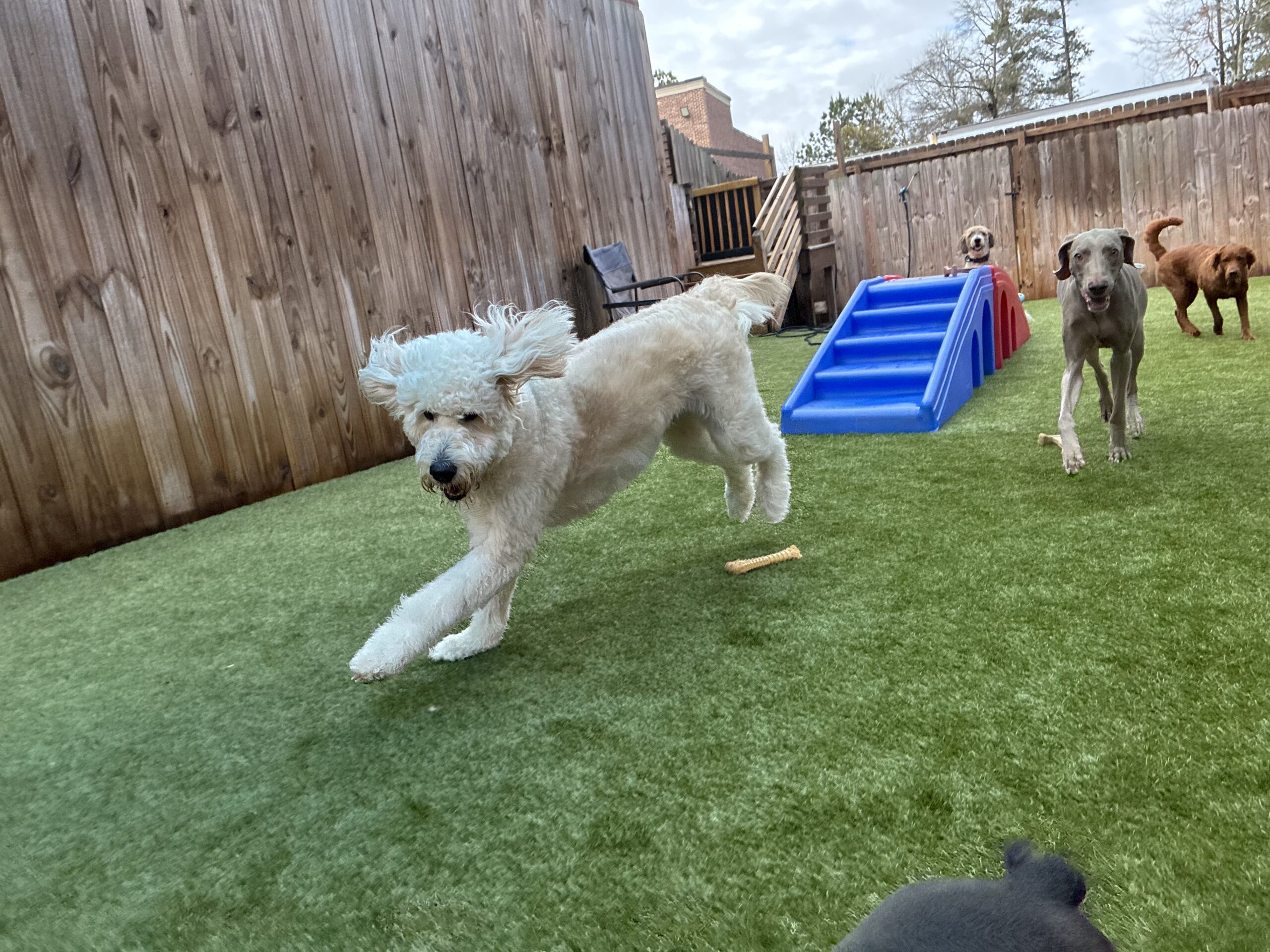
A day at The PawPlex isn’t eight straight hours of dogs running around until they wear themselves out. There’s play, of course, but there’s also time to rest, eat, settle down, and just take a break from all the excitement.
The goal is for your dog to have a full, fun day without going home completely overstimulated.
So, what does a typical day look like?
Dogs usually go out for group play for about 30–45 minutes at a time.
How many play sessions they get can vary a little depending on how many dogs are with us that day, but most dogs get at least two group play sessions in the morning and two more in the afternoon.
Between those sessions, they get time away from the group to relax and recharge.
That downtime is actually a pretty important part of the day. If you’ve ever seen your dog come home from a busy park day completely exhausted but somehow still unable to settle, you already know that more activity isn’t always better. Sometimes they need a chance to come down from all that excitement before jumping back into another round of play.
Meals are worked into the day too. Breakfast is usually served around 7:30–8:00 a.m., lunch around 12:00 p.m., and dinner around 3:30–4:00 p.m.
And no, your dog isn’t eating lunch in the middle of a room full of other dogs staring at their bowl.
Dogs go back to their own accommodations for meals, where they can eat without having to worry about another dog getting too curious about what’s for lunch.
How do you decide which dogs play together?
This is another question we get a lot, especially if you have a smaller dog, a shy dog, or one who plays a little differently from everyone else.
We don’t just look at size and start dividing dogs into groups.
We also look at temperament and how each dog actually likes to play. During a temperament meet and greet, we usually start by introducing a new dog to some of our regular daycare dogs because we already know those dogs really well. That gives us a better idea of how the new dog reacts, what kind of play they enjoy, and which group is likely to make them the most comfortable.
Some dogs walk in and immediately think they’ve arrived at the best party of their life. Others need a little more time to watch everything before deciding they want to join in.
Both are completely normal.
We’re not trying to make every dog behave the same way. We’re trying to figure out where your dog feels most comfortable.
What is someone actually watching during playtime?
A typical play group has around 15–20 dogs with one kennel attendant.
That staff member isn’t just standing there waiting for something to happen. They’re watching how the dogs are interacting, whether everyone still looks comfortable, whether one dog is getting a little too excited, and whether somebody could use a break.
Think about your own dog for a second. You probably know the difference between their normal happy play and the point where they’ve had enough, even if nobody else would notice it yet.
That’s the kind of thing our team is watching for too.
If a dog looks uncomfortable in a group, needs some space, or just seems ready for a break, we can pull them out and let them settle rather than expecting them to keep playing because it’s technically still “playtime.”
What if my dog doesn’t like big groups?
This is important because not every dog wants to hang out with 15 or 20 other dogs, and that doesn’t automatically mean daycare or boarding won’t work for them.
For dogs who aren’t a good fit for regular group play, we have an enrichment option instead.
Depending on the dog, that might mean one-on-one play with a staff member or spending time in a much smaller group of around two or three dogs.
Dogs who are not spayed or neutered by one year old also move into enrichment rather than participating in the regular larger play groups.
There is an additional charge for enrichment, but it gives us another way to care for dogs who may enjoy the day much more without a large group around them.
Because really, the goal isn’t to convince every dog that they should love group play. The goal is to figure out what kind of day actually works for them.
Can my dog get some extra one-on-one attention?
Yes.
If your dog is boarding with us and you know they’re the kind of pup who would happily trade a room full of dogs for ten minutes of someone scratching behind their ears, you can add Cuddle Time for $10.
It gives them about 10–15 extra minutes of one-on-one time with a staff member before bed.
For some dogs, that little bit of quiet attention is exactly what they want after a busy day.
What should I expect when my dog comes home?
For a lot of dogs, the answer is sleep.
Daycare isn’t tiring only because they’ve been running around. They’ve also spent the day smelling new things, interacting with other dogs, watching what’s going on around them, and figuring out how to move through a social group.
That’s a lot for a dog’s brain too.
So if your dog gets home, drinks some water, finds their favorite spot and completely checks out for the evening, that’s usually not surprising.
And if they still have some energy left? That’s normal too. Every dog handles daycare differently, which is exactly why we don’t try to force every dog into the same routine.
If it’s your dog’s first time with us, we’ll start with a temperament meet and greet so we can get to know them and figure out what kind of play group and routine will work best for them.
Ready for a daycare day?
If it’s your dog’s first time with us, we’ll start with a temperament meet and greet so we can get to know them and figure out what kind of play group and routine will work best for them.